Pages

Showing posts with label Business. Show all posts

AT&T shares fall on disappointing results

Thursday, January 27, 2011 0 Comments
NEW YORK (Reuters) – AT&T Inc posted revenue that missed estimates and it added fewer wireless subscribers than expected in its final quarter as exclusive U.S. provider for the Apple Inc iPhone,
Its shares fell 3 percent as some investors were also disappointed by the company's 2011 expectation for earnings per share growth in the mid-single-digit percentage range, according to Piper Jaffray analyst Christopher Larsen.
"The guidance was lower than what people were looking for," Larsen said, noting that investors were worried about how much customer growth AT&T had baked into the estimate.
AT&T said it added 400,000 net contract customers in the fourth quarter compared with the average expectation for almost 504,000 from eight analysts contacted by Reuters.
On the plus side, Larsen said AT&T's addition of 442,000 customers using tablet computers like Apple's iPad were much higher than he had expected. AT&T also cited sales of tablets based on Google Inc's popular Android software.
"That's one of the things they're doing," Larsen said. "They're not just about iPhones. They're selling a lot of other devices."
On Tuesday, AT&T's biggest rival Verizon Wireless reported 872,000 new contract customers. Verizon Wireless said on January 11 that it starts selling iPhone in February, ending AT&T's more than three years of exclusive rights to the popular device.
However, AT&T noted that it still activated 4.1 million iPhones in the quarter, despite widespread expectations that Verizon Wireless would start selling the device early in 2011.
AT&T, the No. 2 U.S. mobile operator on Thursday reported a profit of $1.09 billion, or 18 cents per share compared with a profit of $2.7 billion, or 46 cents per share in the same quarter the year before.
But excluding unusual items, AT&T earned 55 cents per share compared with the average analyst estimate for 54 cents a share according to Thomson Reuters I/B/E/S.
Operating revenue rose 2.1 percent to $31.36 billion from $30.71 billion in the year-ago quarter. On average analysts were expecting revenue of $31.47 billion, according to a poll from Thomson Reuters I/B/E/S.
AT&T said it expects consolidated revenue to grow this year but did not give a specific target.
It said earnings per share growth would be boosted by improvements in both wireless and wireline profit margins.
It said capital spending for the year would be in the low-to-mid $19 billion range and wireless spending increases would be offset by lower wireline capital expenses.
AT&T shares fell to $27.79 in premarket trading after closing at $28.73 on the New York Stock Exchange.
Verizon Wireless is a venture of Verizon Communications and Vodafone Group Plc.
(Reporting by Sinead Carew; editing by Derek Caney, Dave Zimmerman)
»»  read more

Swiss police: blast at Davos hotel, no injuries

0 Comments

DAVOS, Switzerland – A small blast shattered two windows but caused no injuries at a hotel used by top business and political leaders attending the World Economic Forum, Swiss police said Thursday.
The incident occurred on the day French President Nicolas Sarkozy, British Deputy Prime Minister Nick Clegg and former U.S. President Bill Clinton were due to take the stage at the annual gathering in the Swiss Alpine town of Davos.
Forum organizers said in a statement that the explosion was caused by a firework.
An anonymous posting on the website indymedia.ch claimed responsibility for the attack on the Posthotel Morosani, saying it was directed at Swiss government officials and senior executives of Swiss bank UBS staying at the hotel. Its authenticity couldn't immediately be confirmed.
The Swiss federal prosecutors office said in a statement that it is investigating the incident but provided no further information "for tactical reasons."
The explosion happened in a hotel storage room shortly after 9 a.m. local time (0800 GMT) Thursday, regional police spokesman Thomas Hobi told the AP. The hotel did not comment.
The anonymous claim of responsibility said "two pyrotechnical devices and sugar" were used to cause the blast.
The hotel is just over a mile (around 2 kilometers) from the main venue of the annual gathering in the Alpine ski resort.
There was little disruption to the hotel and its activities beyond an increased security presence at the hotel's entrance. Guests, journalists and others were filing through a security scanner that was installed before Thursday's incident.
A Forum-related lunch focusing on organized crime, called "Criminals Without Borders" went on as scheduled at the hotel at noon, with speakers including Colombian President Juan Manuel Santos and Robert Wainwright, the director of Europol, or European Police.
There is tight security at the World Economic Forum as left-wing groups plan to hold a protest this weekend against the annual meeting of political and business leaders and social activists.
Anonymous flyers circulated at a demonstration last week in the northeastern Swiss town of St. Gallen urged activists to "Smash (the) WEF."
The flyer says: "Let us fight together against the unbearable propaganda of capitalism."
Hobi said he expects Saturday's demonstration to be peaceful.
In previous years radical activists have stayed away from the chic ski resort and staged violent demonstrations elsewhere in Switzerland instead.
»»  read more

Australia plans new tax, cuts to pay for floods

0 Comments

CANBERRA, Australia – Australia wants to tax those not affected by massive flooding and cut spending to pay the more than $5 billion bill it is anticipating after weeks of rain swamped the country's third-largest city and forced thousands from their homes.
With its tax proposal Thursday, the government hopes to avoid borrowing to pay for rebuilding after what could prove to the the country's costliest disaster — a decision some economists andbusiness leaders have called into question.
Prime Minister Julia Gillard announced that the temporary tax would apply to Australians on above-average incomes and would exclude those who were affected by the floods. The levy — 0.5 percent on incomes between $50,001 and $100,000, and a 1 percent on taxable incomes above that — is expected to raise $1.8 billion.
A vast inland sea of floodwaters continued creeping across southeastern Australia on Thursday, inundating farms and houses. Dozens of homes were swamped this week.
The flooding has claimed 35 lives, damaged or destroyed 30,000 homes and businesses and caused at least $3 billion in damage to crops and lost coal exports. Brisbane, the country's third-largest city and the capital of hard-hit Queensland state, was under water for days.
Initial estimates of the overall damage plus the cost of emergency grants to flood-affected communities for the federal government is $5.6 billion and likely to rise, Gillard said. The federal government is to pay 75 percent of the cost of rebuilding infrastructure such as roads and ports, while state and local governments will pay 25 percent.
The federal government plans to cut spending in other areas including clean energy industry incentives to make up the remainder of the bill for infrastructure.
"In time, it may prove to be the most expensive natural disaster our nation has ever seen," Gillard told the National Press Club.
She said the government expected the floods to shave half a percentage point from Australia's gross domestic product, which the government predicted in November would grow by 3.25 percent in the current fiscal year ending June 30.
The legislation is to be introduced to Parliament next month. The main opposition party opposes it, but the measure seems likely to pass because Gillard's Labor Party commands a majority in the House of Representatives with the support of independent and Green lawmakers.
Gillard, whose government has vowed to make Australia one of the first developed countries to return its annual budget to surplus two years after the global economic crisis, has dismissed the prospect of borrowing to pay for the flooding damage.
Some economists and business leaders say she should reconsider.
Warwick McKibbon, a central bank director, estimated the cost of reconstruction could be between $10 billion and $20 billion and said the government should keep the budget in deficit for longer to pay that.
"I don't think any great harm would have been done had the government simply allowed the deficit to be larger or the return to surplus be slightly delayed from a schedule that was drawn up well before this most extraordinary disaster," Saul Eslake, an economist with the Grattan Institute think tank, told AustralianBroadcasting Corp. radio.
Western Australia state Premier Colin Barnett, one of only two state leaders who is not a member of Gillard's party, said most Australians would happily pay an extra tax to rebuild Queensland, the worst-affected state in the east.
"I believe most Australians — most West Australians — are willing to contribute a little bit more to help Queensland get back to its feet," Barnett said. "So I think that is appropriate."
»»  read more

Hyundai Motor's 4th-quarter net profit hits record

0 Comments

SEOUL, South Korea – Hyundai Motor's net profit jumped 48 percent in the fourth quarter to a record high as the automaker reaped gains from strong overseas sales.
Hyundai said Thursday that it earned 1.4 trillion won ($1.3 billion) in the three months ended Dec. 31 after recording 946 billion won in profit a year earlier.
Hyundai Motor Co. is South Korea's largest automaker and has become a major force in the global industry by expanding aggressively overseas with factories in China, India, Turkey, the United States, the Czech Republic and, from late last year, Russia. The company and South Korea's Kia Motors Corp. together form the world's fifth-largest automotive group.
Hyundai, the maker of the Elantra and Sonata sedans and the Tuscon SUV, said total sales during the quarter rose 3.1 percent to 9.94 trillion won from 9.65 trillion won a year earlier.
Company spokeswoman Song Meeyoung said that the net profit and sales figures were all-time quarterly highs.
Sales volume increased 5.1 percent to 943,791 vehicles in the fourth quarter and rose 16.3 percent to a record 3.61 million for 2010.
Global market share for all of last year, however, remained unchanged from 2009 at 5.2 percent, Song said.
Annual net profit in 2010 surged 78 percent to 5.27 trillion won, while sales hit 36.77 trillion won, a gain of 15.4 percent. Both figures were also record highs, according to Song.
Hyundai enjoyed strong profitability last year due to strength in its overseas factories and sales operations, which contribute to its net earnings.
The company did not break down its overseas earnings performance for the fourth quarter alone, but said that its operations in China, India, the United States, the Czech Republic and Turkey all contributed to earnings in 2010.
Among those operations, the most notable performer was the United States, where sales volume increased 53.9 percent from 2009 to 300,000 vehicles, while revenue rose 46.8 percent, according to presentation materials for investors.
Operations in China, the world's biggest auto market, were also strong, with sales volume rising 23.3 percent to 703,000 vehicles and revenue gaining 20.8 percent.
Sales during 2010 from overseas factories totaled 1.88 million vehicles, a gain of 25.9 percent from the year before, Hyundai said. Exports of vehicles made in South Korea increased 17.8 percent to 1.07 million.
Greg Kim, an auto analyst at Mirae Asset Securities in Seoul, said that Hyundai's overseas factory sales during the final three months of last year reached their highest quarterly level ever.
"All the overseas factories, they performed very well," he said.
Hyundai Motor's share price fell 0.8 percent to close at 196,000 won, though remains 13 percent higher so far this year. The company's stock price rose 43 percent in 2010.
»»  read more

Oil holds above $87 a barrel in Asia

0 Comments

BANGKOK – Oil prices held above $87 a barrel Thursday in Asia as traders weighed President Barack Obama's plans to boost the U.S. economy against the possibility that China, the world's biggest energy consumer, will soon raise interest rates to slow growth and contain inflation.
Benchmark crude for March delivery was down 21 cents at $87.10 a barrel at late afternoon Bangkok time in electronic trading on the New York Mercantile Exchange. The contract rose $1.14 to settle at $87.33 a barrel on Wednesday.
It was the first significant move higher for oil in a week after prices tumbled on signs the Organization of Petroleum Exporting Countries, which produce about 40 percent of the world's crude, could raise production to bring down the price of oil.
Traders are now taking their cue from world stock markets, which moved higher on Obama's call in the State of the Union address to close corporate tax loopholes and lower business tax rates — moves that could stimulate the world's biggest economy and boost demand for fuel.
But the possibility China may raise interest rates or take other tightening measures before Lunar New Year holidays begin next week kept a lid on the oil price in Asian trading on Thursday.
"There is still a strong probability that China's central bank will raise interest rates or increase reserve requirements again to cool economic growth there," energy consultants Cameron Hanover said in a report.
Adding to the caution, the Energy Department said U.S. stockpiles of oil and gasoline rose more than expected last week.
Crude supplies expanded by 4.8 million barrels to 340.6 million barrels. Gasoline supplies rose by 2.4 million barrels to 230.1 million barrels, while demand in the past four weeks increased 1.1 percent. Supplies of distillate fuel, which includes diesel and heating oil, declined by 100,000 barrels to 165.7 million barrels.
In other Nymex trading in February contracts, heating oil was down 0.4 cent at $2.666 a gallon and gasoline fell 0.2 cent to $2.429 a gallon. Natural gas for March delivery slipped 2 cents to $4.48 per 1,000 cubic feet.
In London, Brent crude was up 1 cent at $97.92 a barrel on the ICE Futures exchange.
»»  read more

Wall St opens flat as data offsets Caterpillar

1 Comments

NEW YORK (Reuters) – Stocks opened flat on Thursday as disappointing data on the labor market offset strong results from Dow component Caterpillar.
The Dow Jones industrial average (.DJI) was down 3.63 points, or 0.03 percent, at 11,981.81. The Standard & Poor's 500 Index (.SPX) fell 0.24 points, or 0.02 percent, at 1,296.39. The Nasdaq Composite Index (.IXIC) was up 6.26 points, or 0.23 percent, at 2,745.76.
»»  read more

BlackRock's Fink Says He Never Believed in El-Erian's `New Normal' Economy

Tuesday, January 25, 2011 0 Comments

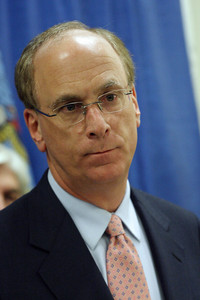
Laurence D. Fink, chief executive officer of BlackRock Inc., said he never thought the U.S. would enter a prolonged phase of below-average economic growth described by Mohamed El-Erian, CEO of Pacific Investment Management Co.

“We never believed in the ‘new normal,’ ” Fink said today on a conference call presenting fourth-quarter earnings for New York-based BlackRock. “We were always talking about a U.S. economy growing 3 plus percent.”

Accelerating growth, fueled by government stimulus and a second round of asset purchases by the Federal Reserve, has prompted economists to lift forecasts. El-Erian, who helped coin the term “new normal” about two years ago to describe the long-term impact of the worst recession since the Great Depression, in December raised his U.S. economic forecast, while cautioning that the recovery may not last.
Source:http://www.bloomberg.com/news/
Fink, although he never fully embraced Pimco’s philosophy, previously used the term new normal to describe a gradual recovery as the U.S. emerged from the credit crisis.

“We believe we are in the midst of a recovery in our economies, albeit a slow one,” Fink said in an interview with Bloomberg Television on June 12, 2009. “We’re not forecasting an economy that’s back to normal. It’s more a new normal.”

Fink, 58, built BlackRock from a bond shop into the world’s largest asset manager with a series of takeovers, including the 2009 purchase of Barclays Global Investors.

‘Greatest Failures’

The firm didn’t benefit as much as Pimco from more than $600 billion in industrywide deposits into bond mutual funds in 2009 and 2010. A former bond trader, Fink today said it was “one of the greatest failures” of BlackRock that it didn’t attract a larger share of that money.

Pimco’s $240 billion Total Return Fund doubled in size since 2007, and became the world’s largest mutual fund as investors fled to the safety of bonds. Pimco’s mutual funds attracted $64 billion in deposits in 2010, according to data from Morningstar Inc. in Chicago.

The $3.4 billion BlackRock Total Return fund, which has beaten 93 percent of peers over the past five years, declined 11.1 percent in 2008, according to data compiled by Bloomberg. The Pimco Total Return fund rose 4.7 percent in 2008, and has beaten 99 percent of peers over the past five years.

“We did not benefit like some of our great competitors did in the fixed-income flows, and it was a disappointment,” Fink said today. “And obviously our performance in 2008 was a chief cause of that.”

Equities Shift

Pimco is forecasting an end to the 30-year bond rally that has fueled much of its growth, and last year started expanding into equities.

BlackRock, which acquired Merrill Lynch & Co.’s money- management unit in 2006 to expand its equity business, has almost half of its $3.56 trillion in managed assets in stocks. Fink said today that BlackRock stands to benefit if an improving market prompts investors to “re-risk” and move from bonds to equities.

Under Pimco’s philosophy, the growth in the U.S. economy will be below historical norms for years to come because it is saddled with high levels of debt, higher unemployment, faces more regulation and a smaller role in the world economy.

El-Erian, 52, in December raised the forecast for the U.S. after stimulus from the Federal Reserve, saying the economy will grow 3 percent to 3.5 percent in the fourth quarter of 2011, compared with its previous forecast of 2 percent to 2.5 percent.

The median forecast for U.S. GDP growth in 2011 rose to 3.1 percent in January, up from 2.6 percent in December, according to a monthly Bloomberg News survey of economists.

To contact the reporter on this story: Sree Vidya Bhaktavatsalam in Boston at sbhaktavatsa@bloomberg.net.

To contact the editor responsible for this story: Christian Baumgaertel at cbaumgaertel@bloomberg.net.
»»  read more

Stocks Bounce Late to Finish Flat

12 Comments

NEW YORK (TheStreet) -- Stocks staged a smart recovery late in Tuesday's session to finish right around the flatline ahead of President Obama's State of the Union address tonight.
The Dow Jones Industrial Average finished 3 points, or 0.03%, lower at 11,977, after dropping more than 80 points earlier in the session to 11,898. TheS&P 500 settled with an incremental gain at 1291, bouncing roughly 10 points off its session-low. TheNasdaq Composite managed to add nearly 2 points, or 0.06%, to close at 2719.


Wal-Mart(WMT_), Verizon(VZ_) and Cisco Systems(CSCO_) led the Dow higher, while American Express(AXP_), Bank of America(BAC_) and Johnson & Johnson(JNJ_) were among the blue-chip index's bigger losers. Breadth within the Dow was negative with 17 of its 30 components moving lower.

Stocks were in the red for most of the trading session Tuesday as investors digested mixed reports from a number of Dow components.

Verizon missed expectations but raised profit and sales targets driven largely by wireless and high hopes for its business with Apple's(AAPL_) iPhone. Johnson & Johnson met profit forecasts but fell short of revenue estimates. AmEx, which reported after Monday's closing bell, also disappointed Wall Street.

3M(MMM_) topped expectations despite a slight dip in quarterly profits and raised its sales outlook for 2011. DuPont (DD_) and Travelers(TRV_) also beat analyst views.

Overall, market breadth was even by the end of the trading session, with about 49% of stocks on the New York Stock Exchange losing ground, and 48% finishing in positive territory. Consumer cyclicals and telecom showed the most gains while basic materials was the weakest sector.

Early Tuesday, the Conference Board said consumer confidence jumped to 60.6 in January -- an eight-month high -- from 53.3 in December. The level far exceeded economists' expectations for a January reading of 53.5, according to Briefing.com.
"The international market is definitely playing a bigger role for larger U.S. companies, and those are the companies that are feeling a pinch as the global market begins to slow in some areas," said Daniel Penrod, senior industry analyst for the California & Nevada Credit Union Leagues, about some of the recent earnings misses. "The hope had been that the international market would pull the U.S. through but we're seeing less stability than we previously thought."
»»  read more

State of the Union: Obama calls for unity, yet challenges GOP

0 Comments

The president's State of the Union message focuses on bipartisanship and offers proposals sure to please conservatives. But the broad outlines of his expected reelection run are clearly visible.

Reporting from Washington —

The moment was tailor-made for President Obama, who rose to national fame seven years ago on a call for unifying America's blue and red states.

Standing before a divided Congress on Tuesday, with Democrats and Republicans seated side-by-side in a nod to comity, he delivered the appeal for unity many were expecting him to give.

"Governing will now be a shared responsibility between parties," he said. "We will move forward together, or not at all."

But the political reality behind his rhetoric was light-years removed from his lofty 2004 Democratic convention debut, when the then-Senate candidate from Illinois declared that "there's not a liberal America and a conservative America; there's the United States of America."

Now, a president at midterm, he's wiser and battle-scarred, and appears to have bounced back from the November election that delivered what he had described as a "shellacking."

With a much-discussed, and thus far successful, turn toward the center, he has strengthened his hand as he prepares to battle Republicans in Congress and launch his reelection campaign.

Another president might have used the occasion to reset his relationship with the voters. President Clinton, in his 1995 State of the Union, after Republicans took over Congress, frankly admitted he'd "made my mistakes" and learned "the importance of humility."

Obama did no such thing.

Last month's bipartisan tax deal with Republicans and his recent address to a memorial service for victims of the Tucson shootings have lifted his popularity, polls show. Emboldened by his rebound, he seems prepared to go after Republicans with renewed confidence.

As much as anything, Tuesday night was about winning this year, a pivotal time of testing for Obama and Republicans that sets the stage for the 2012 presidential election. Aside from the flowery rhetoric and pleas for bipartisan cooperation, his speech was something of a throw-down to conservative lawmakers.

"At stake right now is not who wins the next election," Obama said, answering those who had described his remarks as an unofficial campaign kickoff.

Still, the broad outlines of an all-but-announced reelection run were clearly visible: a renewed call to raise taxes on the very wealthy, a promise of more higher-education aid for the middle class, new federal initiatives in scientific research and energy technology, and a renewed focus on jobs, in the form of fresh spending for road and bridge repair and high-speed rail construction.

For mainstream voters, particularly the independents whose mood swings dominate today's politics, he offered a more tight-fisted, business-friendly approach to governing than his first two years in office, which were heavy on big federal initiatives.

For conservatives, there were proposals to lower the corporate tax rate, reduce medical malpractice costs and let ROTC and military recruiters back on all college campuses. For those on the left, there was a new push for immigration reform, a pledge to protect Social Security from efforts to privatize or slash benefits and a renewed vow to start withdrawing U.S. forces from Afghanistan next summer.

"Winning the future," a campaign-style slogan Obama used repeatedly, is how the White House branded the speech (unaware, apparently, that prospective Republican presidential candidate Newt Gingrich wrote a book with that title a few years back).

In contrast to GOP demands for deep cuts in spending, he delivered a lengthy sales pitch for a series of new initiatives designed to be paid for by cuts elsewhere. His top economic advisor, Gene Sperling, acknowledged that Obama's call for a spending freeze on non-security discretionary spending amounted to little more than a "down payment" on the debt-reduction challenge the president largely avoided in his speech.

But by adding two years to an earlier freeze proposal that went nowhere (when Democrats had large majorities in Congress), Obama wants voters to see he's serious about taking a more austere approach to spending, once the economy recovers.

Still, his budget, to be released next month, will probably call for hundreds of billions more in spending in coming years than the House Republican Study Committee recently proposed.

Obama sought to frame the upcoming spending debate in terms of America's global competitiveness.

He couched his plan for new federally funded clean-energy research as "our generation's Sputnik moment." In doing so, he appeared to be playing on fears of a rising China in the same way that earlier presidents exploited Cold War concerns about the Soviet Union, though his proposal does not approach the scale of the U.S. space program and may not get the same positive response from Congress.

House Speaker John A. Boehner (R-Ohio) said earlier Tuesday that he was "hopeful that the word 'investment' really isn't more stimulus spending and a bigger government here in Washington."

Wisconsin Rep. Paul D. Ryan, in a prereleased transcript of his televised Republican response, warned that America is at "a tipping point" and that without the spending cuts the GOP is proposing the "next generation will inherit a stagnant economy and a diminished country."

The president's speech was a clear-eyed reflection of where he stands. His agenda going forward is minimalist, especially when compared with the big gains of his first two years. Safeguarding those achievements against Republican efforts to roll them back have become his overarching goal.

Self-assured and increasingly comfortable in his role as national leader, Obama proved again Tuesday night that he can seize the big moment. If the political winds continue to blow his way, he will be a formidable foe for the Republicans, this year and next.

paul.west@latimes.com

Source:http://www.latimes.com/

»»  read more

Foreclosures Poised to Rise in 2011

Monday, January 17, 2011 0 Comments

(NEW YORK) — The bleakest year in the foreclosure crisis has only just begun.

Lenders are poised to take back more homes this year than any other since the U.S. housing meltdown began in 2006. About 5 million borrowers are at least two months behind on their mortgages and industry experts say more people will miss payments because of job losses and also loans that exceed the value of the homes they are living in.

"2011 is going to be the peak," said Rick Sharga, a senior vice president at foreclosure tracker RealtyTrac Inc. The firm predicts 1.2 million homes will be repossessed this year.

The blistering pace of foreclosures this year will top 2010, when a record 1 million homes were lost, RealtyTrac said Thursday.

One in every 45 U.S. households received a foreclosure filing last year, a record 2.9 million of them. That's up 1.67 percent from 2009.

On Thursday, Freddie Mac reported that fixed mortgage rates dipped this week for the second straight time, extending a sliver of hope for some home owners.

The average rate on the 30-year mortgage dropped to 4.71 percent from 4.77 percent the previous week. The rate on the 15-year loan, a popular refinance choice, slipped to 4.08 percent from 4.13 percent.

But both are a half-point higher than the lows they reached in November. The 30-year loan rate hit a 40-year low of 4.17 percent and the 15-year mortgage rate fell to 3.57 percent, the lowest level on records starting in 1991.

The dip has led more borrowers to apply for a refinance, but would-be buyers remain hesitant, according to Wednesday's mortgage indexes from the Mortgage Bankers Association. It will take more than low mortgage rates to jumpstart a housing market plagued by high unemployment, falling prices, tighter credit standards.

The glut of foreclosures has compounded the problem and while the pace moderated in the final months of 2010, that isn't expected to last.

Foreclosures are expected to remain elevated throughout the year, pushing home prices down another 5 percent nationally before finally bottoming out.

The number of homes that received at least one foreclosure-related filing in December was the lowest monthly total in 30 months. Total notices fell 1.8 percent from November and 26.3 percent from December 2009, RealtyTrac said.

Banks temporarily halted actions against borrowers severely behind on their payments after allegations of improper eviction surfaced in September.

However, most banks have since resumed foreclosures and the first quarter will likely bear that out, Sharga said.

The pain likely will be the most acute in states that have already suffered the worst. For the most part, it will be states that saw the biggest housing booms: Nevada, Arizona, Florida and California. They will be joined by states hit hardest by the economic downturn, including Michigan and Illinois.

And on Wednesday, Illinois lawmakers approved a 66 percent income-tax increase in a desperate bid to end the state's crippling budget crisis.

More than half of the country's foreclosure activity came out of five states in 2010: California, Florida, Arizona, Illinois and Michigan. Together, these states recorded almost 1.5 million households receiving a filing, despite year-over-year decreases in California, Florida and Arizona.

Nevada posted the highest foreclosure rate in 2010 for the fourth straight year, despite a 5 percent decline in activity from the year before. One in every 11 households received a foreclosure filing last year in the state. In December, foreclosure activity increased 18 percent from November with a 71 percent spike in bank repossessions.

Arizona and California also showed sharp December increases in the number of homes that banks reclaimed, at 52 percent and 47 percent, respectively. Arizona, along with Florida, finished the year at No. 2 and No. 3 for the highest foreclosure rates.

One in every 17 Arizona households got a foreclosure filing last year, while one in 18 received a notice in Florida.

California, Utah, Georgia, Michigan, Idaho, Illinois and Colorado rounded out the top ten states with the highest foreclosure rates.

RealtyTrac tracks notices for defaults, scheduled home auctions and home repossessions — warnings that can lead up to a home eventually being lost to foreclosure.


Source: Time Magazine
Read more: http://www.time.com/time/business/article/0,8599,2042515,00.html#ixzz1BMrtP6jx
»»  read more

Apple Beware: Enter the New iPad Rivals

0 Comments

Tablets may have been the most talked-about new gizmos of 2010, but nearly all the talk was about one model: Apple's iPad, which instantly defined the category when Steve Jobs unveiled it nearly a year ago. By the end of the year, only one serious iPad alternative — Samsung's diminutive Galaxy Tab — had gone on sale.

And then there was the tablet coming-out party that was last week's International Consumer Electronics Show (CES). The cavernous Las Vegas Convention Center positively bulged with the things, including newly announced contenders from Dell, Motorola, Panasonic, Toshiba and other tech behemoths, as well as smaller players such as HDTV manufacturer Vizio and bargain-basement dweller Coby. Even Polaroid was showing one.

Despite the flurry of activity, the rest of the industry is still scrambling to answer the iPad. It'll be a few months before it's possible to separate the winners from the also-rans: no major debutante was available for immediate purchase, most manufacturers were cagey about pricing, and some models don't have names yet.

Motorola's Xoom made the biggest splash, snagging best-of-show honors out of 20,000-plus products that premiered at CES. Its 10.1-in. widescreen display is a skosh roomier than the 9.7-in. one on the iPad, and unlike Apple's cameraless tablet, it has cameras on the back (for snapshots) and front (for video calls). The Xoom will be sold with Verizon wireless service — 3G at first, with a free upgrade to the much zippier new LTE network in the second quarter of this year. (If you cringe at the prospect of a hefty monthly bill for wireless data, Toshiba's unnamed model — similar to the Xoom, but sporting only wi-fi — might be more alluring.)

Like most of the new tablets, the Motorola and Toshiba models will run Google's Android operating system. Android 3.0 Honeycomb, the first version designed with tablets in mind instead of smart phones, looks promising, with an all-touchscreen interface replacing the excess of buttons that has hobbled earlier releases. It's also got versions of Gmail, Google Maps and other Google apps that take advantage of tablets' relatively roomy screens, rather than simply stretching the smart-phone versions to fill up more space.(Get the latest tech news at Techland.com.)

Honeycomb needs to be ready for tablets that will ship within a month or two, but it wasn't ready for CES: the Xooms at the show displayed a video loop of the new version, not the real thing, and Toshiba's tablet was running an older version of Android. It's therefore dangerous to get too excited about it just yet. I also fret that the industry's reliance on one software supplier may result in most models' feeling like bland kissing cousins. (It's tough for companies to differentiate tablets through hardware design alone. In the end, they're all skinny slabs of various sizes.)

While Google may just be getting into the tablet game, it already has a daunting head start on Microsoft, a perverse state of affairs considering that the latter company started trying to popularize tablets more than a decade ago. Microsoft's Tablet PCs never caught on; nor did Slate PCs, the entertainment-centric devices that got a brief moment of glory when CEO Steve Ballmer introduced them at CES 2010.

For CES 2011, Microsoft had one bit of news that could eventually be a huge deal: it's working on a version of Windows that will run on processors based on technology from ARM, the company whose designs are inside most tablets, smart phones and other new-wave computing devices. (Current versions of Windows require x86 processors from firms such as Intel and AMD — powerful, energy-hungry chips that are more at home in desktop PCs and laptops than in tablets.)

Microsoft wouldn't say when the new edition of Windows will be ready — think 2012 or later — and it isn't talking about how it will rejigger the Windows interface to work better on devices that don't have a keyboard or mouse. A few companies did announce tablets at the show based on the current version of Windows, like Samsung's odd-but-clever Slider PC, which tucks a pop-out keyboard underneath its touchscreen. But there won't be an onslaught of new Windows tablets until there's a Windows designed with today's tablets in mind.

A few manufacturers are going their own way. BlackBerry maker RIM assembled its own potent software platform for its 7-in. PlayBook, which it announced back in September and plans to ship early this year, starting at less than $500; the units available for test drives at RIM's CES booth looked at least as impressive as any Android-powered alternative. (It's still not clear, however, whether RIM sees the PlayBook as a fearsome iPad killer or as an accessory for BlackBerry addicts.) And HP is expected to use a Feb. 9 press event to announce one or more tablets based on WebOS, the slick operating system it picked up when it acquired mobile pioneer Palm last July.

Oh, and one more tablet should show up before long: the second-generation iPad. As usual, Apple is staying mum until the moment it's ready to put its hype machine into overdrive. But industry watchers have already tried to puzzle out the likely improvements: dual cameras, a higher-resolution screen, possibly a memory-card slot. Many already-announced tablets match those features. But the 2011 iPad will pack a software upgrade too, and nobody else in the business has yet proven that it can keep pace with Apple when it comes to integrating hardware, software and services into one satisfying experience. In other words, it won't be the least bit surprising if this year's most compelling iPad alternative turns out to be another iPad.


Source: Time Magazine
Read more: http://www.time.com/time/business/article/0,8599,2042073,00.html#ixzz1BJRyS0Dc
»»  read more
 
Copyright © Scandal-Teen-Thời Trang -Tin tức - Âm nhạc - Điện Ảnh - Chuyện sao-Lộ Hàng
Blogger Theme by BloggerThemes Sponsored by Busy Buzz Blogging